
Sindh Traffic Challan & Sindh Excise : Easy Fast Way to Pay 2026
Karachi vehicle owners often use the words traffic challan, e-challan, Excise challan, and vehicle tax challan as if they mean the same thing. They do not necessarily refer to the same service. Understanding the difference is important because the authority, purpose, checking method, payment process, and available online service can be different.
A traffic violation challan generally relates to an alleged violation of traffic rules and is handled through the relevant traffic enforcement authority. Sindh Excise, Taxation and Narcotics Control Department, on the other hand, provides motor vehicle registration, ownership, taxation, vehicle verification, and related online services. Its online system includes Motor Vehicle Tax payment, Quick Pay, vehicle verification, tax calculation, and paid challan or payment-history functions.
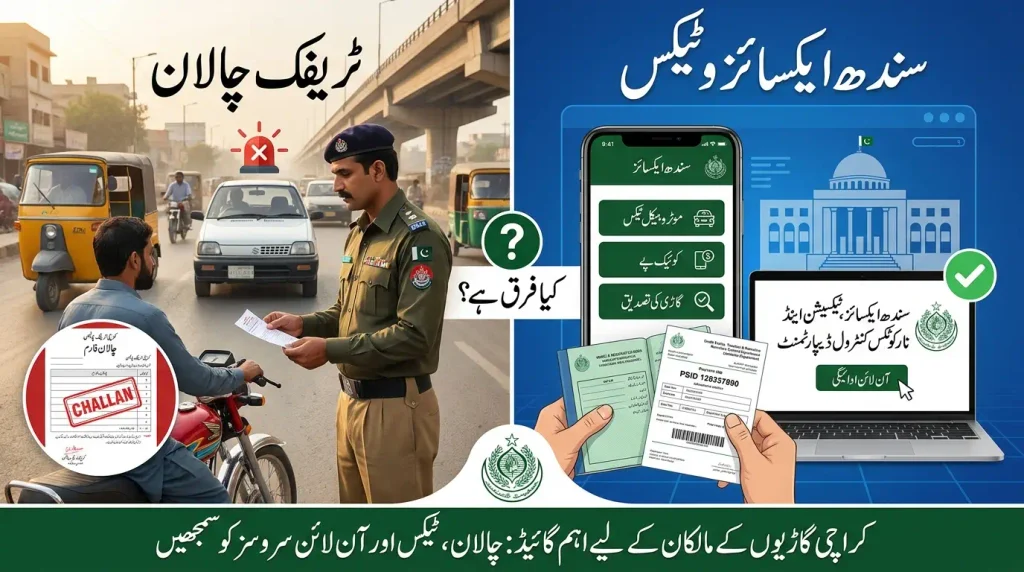
This distinction matters when a vehicle owner searches online for a Karachi challan. If the purpose is to check a traffic violation, the correct traffic-enforcement service should be used. If the purpose is to check or pay annual Motor Vehicle Tax, verify a vehicle record, generate a PSID, or obtain proof of a tax payment, the relevant Sindh Excise service is appropriate.
This guide explains the Sindh Excise side of the process in detail while also clarifying where it differs from a Karachi traffic violation challan. It covers vehicle verification, Motor Vehicle Tax, Quick Pay, PSID generation, online payment, EasyPaisa and JazzCash options, paid challan retrieval, reprinting, and tax-update timing
Is Karachi Traffic Challan the Same as a Sindh Excise Motor Vehicle Tax Challan?
Two Different Purposes
No. A Karachi traffic challan and a Sindh Excise Motor Vehicle Tax payment should not automatically be treated as the same type of record. A traffic challan is connected with enforcement of traffic rules, while Motor Vehicle Tax is a government vehicle-related tax administered by Sindh Excise.
The difference becomes particularly important when someone receives a message, sees a payment reference, or searches for a vehicle record online. A person looking for an unpaid traffic violation should use the applicable traffic-enforcement verification service. A person trying to determine whether annual vehicle tax has been paid should use the Sindh Excise tax service.
Sindh Excise officially describes Motor Vehicle Tax as part of its vehicle registration, ownership transfer, and taxation services for private and commercial vehicles across Sindh. Its computerized vehicle registration and tax system connects Karachi with regional directorates, supporting coordinated vehicle records and taxation services.
Why the Difference Matters
Using the wrong online service can lead to confusion. For example, finding a Motor Vehicle Tax payment record does not necessarily mean that a separate traffic violation record has been cleared. Likewise, a traffic violation record should not be assumed to be an annual vehicle-tax record simply because both are connected with the same vehicle.
Before making any payment, check what the demand actually represents. Look for the authority name, vehicle registration information, payment reference, date, amount, and purpose. If the record concerns Motor Vehicle Tax, the Sindh Excise payment system and its PSID process are relevant. If it concerns a traffic violation, use the appropriate traffic authority’s official verification and payment process.
How to Check Your Vehicle Through Sindh Excise
Search by Registration Number
Sindh Excise provides an official Online Vehicle Verification service. The current vehicle-verification interface asks the user to select a vehicle category and enter the registration number. The available categories include four-wheelers and two-wheelers.
The registration number should be entered carefully and in the format shown on the vehicle’s number plate. A small typing error can prevent the system from finding the expected record. When checking a vehicle, it is therefore useful to keep the registration document or number plate information available.
The purpose of vehicle verification is different from checking a traffic violation. Vehicle verification is focused on the official motor vehicle record available through the Excise system. It should not be interpreted as a universal search for every possible traffic offence associated with a vehicle.
Vehicle Verification by CNIC
Sindh Excise also provides a CNIC-based vehicle verification service. This service is designed to find available vehicles registered against a specified CNIC. The current service asks for the vehicle category and a 13-digit CNIC, with dashes described as optional in the interface.
This service can be useful when a vehicle owner wants to review the vehicles associated with their identity record. The result is still an official vehicle-record service rather than a general traffic-challan search.
When entering identification information, users should make sure they are using the official government service and should avoid sharing CNIC information through unofficial forms, messages, or unfamiliar websites.
What Is Sindh Excise Motor Vehicle Tax?
Purpose of Motor Vehicle Tax
Motor Vehicle Tax is a vehicle-related tax administered by Sindh Excise. The department describes its Motor Vehicle Tax services as covering vehicle registration, ownership transfer, and tax administration for private and commercial vehicles across Sindh.
The amount payable can depend on details such as vehicle category, engine capacity, vehicle value, registration status, and the applicable transaction or payment date. Because charges and schedules can change, vehicle owners should rely on the amount calculated by the official system rather than an old amount copied from an unrelated page or previous receipt.
Why Your Tax Record Matters
A current tax record can be important when dealing with vehicle-related administrative matters. A payment record provides evidence that a particular Motor Vehicle Tax transaction was processed, while the vehicle record helps establish the information maintained by the department.
Keeping the paid challan or payment receipt is therefore useful. It can help the owner maintain a personal record of the transaction and can provide proof of payment when documentation is required. Sindh Excise states that after online tax payment there is no need to obtain a stamp on the vehicle book merely as proof of that online payment; a printed copy of the paid challan is described as sufficient proof.
What Is Sindh Excise Quick Pay?
Quick Pay Is Designed for Faster Tax Payment
Quick Pay is a Sindh Excise service intended to provide a faster route for paying Motor Vehicle Tax. Unlike the standard account-based tax-payment process, the official FAQ states that Quick Pay does not require the user to register an account.
The current Quick Pay interface asks the user to select a vehicle type, enter a mobile number, provide the registration number, and complete the displayed security check. After vehicle details are retrieved, the system can calculate the applicable amount and provide the option to generate a PSID.
Basic Quick Pay Flow
The normal Quick Pay flow is straightforward. First select whether the vehicle is a four-wheeler or two-wheeler. Next enter the requested mobile number and registration number. After completing the security check, use the vehicle-details option to retrieve the available record.
Once the vehicle information is available, the system provides a calculation step. Review the displayed tax information carefully before generating the PSID. The calculated amount should be checked against the vehicle details so that the payment is made against the intended vehicle.
After generating the PSID, the user can proceed through one of the available payment methods. The current Quick Pay interface identifies options including ATM, net banking, branchless banking, over-the-counter payment, and online payment. The payment screen may also present digital options such as debit or credit card, EasyPaisa and JazzCash, and account transfer.
What Is PSID in Sindh Excise Tax Payment?
PSID Is the Payment Reference
PSID stands for a payment identifier used by the Sindh Excise online tax-payment process. According to the department’s FAQ, it is a 12-digit unique code generated against the selected vehicle for paying the tax.
The PSID connects the payment transaction with the vehicle and the amount calculated by the system. When paying through an available banking channel, the user enters the PSID so that the relevant payment details can be retrieved before confirmation.
PSID Validity Period
The official Sindh Excise FAQ states that a PSID remains valid for the next 24 hours after it is generated. If multiple PSIDs are generated for the same vehicle, the FAQ states that the most recent PSID is the valid one.
This means a vehicle owner should avoid repeatedly generating new PSIDs without checking which one is current. Before making payment, confirm that the PSID displayed in the payment process corresponds to the latest generated reference.
If a PSID has expired, the sensible approach is to return to the official tax-payment service and generate a new payment reference rather than attempting to rely on an outdated reference.
How to Pay Sindh Excise Motor Vehicle Tax Online
Payment Through Banking Channels
After generating a valid PSID, Sindh Excise provides several ways to make Motor Vehicle Tax payment. The official process includes channels connected with 1LINK, with instructions for ATM payments, over-the-counter payments, branchless banking, and mobile or internet banking.
For ATM payment, the official instructions describe selecting the bill-payment or payment section and choosing the relevant 1BILL invoice or voucher option. The 12-digit PSID is then entered. The system can retrieve the payment details associated with the PSID, after which the amount can be confirmed for payment.
For mobile or internet banking, the user logs into the bank’s application or online banking service, selects the relevant 1BILL invoice or voucher payment option, enters the PSID, reviews the fetched information, and confirms the transaction.
EasyPaisa and JazzCash Options
Yes. The official Sindh Excise information includes EasyPaisa and JazzCash-related payment routes. The FAQ describes branchless banking through an EasyPaisa or JazzCash mobile account, while the current Quick Pay payment interface also displays EasyPaisa and JazzCash among its digital payment options.
For a wallet-based payment route, the exact options displayed can depend on the current payment interface. Users should follow the instructions shown by the official service at the time of payment and carefully confirm the PSID and amount before approving the transaction.
The department also describes an over-the-counter route through 1LINK member bank branches or branchless agents. The PSID is used as the payment reference so that the payment can be applied to the appropriate tax transaction.
Online Digital Payment
The Sindh Excise payment system also provides an online payment route. The current Pay Online interface allows a user to search a PSID and provides digital payment options. The displayed payment choices include debit or credit card, EasyPaisa and JazzCash, and account transfer.
Payment screens can change as government services are updated, so users should follow the options presented by the current official interface. Bank or payment-provider charges may also apply where stated by the payment service.
How to Download a Paid Sindh Excise Challan
Print Paid Challan or Tax Payment History
After a successful Motor Vehicle Tax payment, the official Sindh Excise FAQ states that the paid challan can be downloaded through the Print Paid Challan / Tax Payment History option. This gives the vehicle owner a way to retain a record of the completed transaction.
A paid challan is different from a newly generated PSID. The PSID is a payment reference used before or during the payment process. The paid challan is evidence of a completed payment. Keeping both the PSID information and final paid receipt can be useful until the transaction has been fully confirmed.
Reprinting a Previously Paid Challan
Sindh Excise currently provides a dedicated Re-Print Challan service. The displayed form asks for the vehicle type, registration number, and challan paid date, along with a security check before verification.
This is useful when a vehicle owner has already paid the tax but no longer has the original printed copy. Instead of assuming that a new payment is required, the owner can use the official reprint function to check whether the previous payment can be retrieved.
It is important to enter the original registration information and paid date accurately. The purpose of the reprint function is to retrieve an existing payment record, not to generate a second payment for the same tax period.
Does Sindh Excise Motor Vehicle Tax Update After Online Payment?
Real-Time Update After Successful Transaction
Yes. The official Sindh Excise FAQ states that Motor Vehicle Tax updates in real time after a successful transaction from the consumer end. This means that once the payment is successfully processed, the tax record is intended to reflect the completed transaction without requiring a separate manual payment confirmation from the vehicle owner.
However, a payment should not be considered complete merely because a user reached the payment screen. The transaction needs to be successfully processed. Confirmation messages, payment status, and the paid challan are useful records to retain.
Keep the Confirmation Record
After payment, Sindh Excise states that a confirmation SMS is sent to the registered mobile number. Depending on the payment channel, the bank or payment provider may also send its own confirmation message.
Do not delete the confirmation immediately. Save the message, paid challan, transaction information, and other relevant details until you have confirmed that the tax record has updated correctly.
Important Tips Before Paying a Karachi Vehicle Tax Challan
Identify the Issuing Authority
Before paying any vehicle-related demand, identify the authority responsible for it. This is the first and most important distinction in the entire process. A Motor Vehicle Tax demand belongs to the vehicle-tax administration process, while a traffic violation challan belongs to traffic enforcement.
Do not assume that every message containing the word “challan” is a traffic fine or that every vehicle-related payment is a tax payment. Read the transaction details and use the relevant government service.
Verify Vehicle Information
Check the registration number before generating a PSID or making a payment. A vehicle number entered incorrectly can result in the wrong record being displayed or the search failing completely.
When using vehicle verification, select the correct vehicle category and enter the registration number as shown in the official record. If the result appears inconsistent with your documents, stop and verify the information before proceeding with payment.
Save Proof of Payment
After completing the payment, retain the confirmation SMS and paid challan. A digital copy is easy to store and can be printed later if necessary. Sindh Excise specifically states that the printed paid challan is sufficient proof for online tax payment in the context described by its FAQ.
Saving the record also helps if the vehicle owner later needs to check the tax history, reprint the receipt, or investigate a payment that appears not to have been reflected correctly.
Frequently Asked Questions About Karachi Traffic Challan and Sindh Excise
Final Thoughts
When dealing with a Karachi vehicle-related challan or payment, first identify whether you are dealing with a traffic violation or Sindh Excise Motor Vehicle Tax. This single distinction prevents many common mistakes. A traffic violation should be checked through the relevant traffic-enforcement service, while Motor Vehicle Tax, vehicle verification, Quick Pay, PSID generation, and tax-payment history are handled through the applicable Sindh Excise services.
If you are paying Motor Vehicle Tax through Sindh Excise, verify the vehicle registration details before generating the PSID. Remember that the PSID is a 12-digit payment reference and, according to the department’s FAQ, remains valid for 24 hours. If another PSID is generated for the same vehicle, the latest one is the valid reference.
After payment, wait for the successful transaction confirmation and retain the confirmation SMS and paid challan. Sindh Excise states that Motor Vehicle Tax updates in real time after a successful transaction. If you need another copy later, the department provides payment-history and reprint functions.
Finally, never assume that a message, payment request, or online record is genuine merely because it contains your vehicle number. Use the official government service, confirm the authority and purpose of the payment, and enter personal or payment information only into the appropriate official portal.
Understanding the difference between Karachi traffic challan and Sindh Excise Motor Vehicle Tax makes the entire process easier. Traffic enforcement and vehicle taxation may both involve the same vehicle, but they serve different purposes and can require different verification and payment procedures.