
Traffic Challan PSID Check Online 2026 – Easy Punjab Guide
Traffic challan PSID check online is commonly searched by Punjab drivers who want to verify a traffic ticket, find its payment reference, or confirm what to do with a PSID they have received. The most important point is that a PSID and a challan search are not exactly the same thing. A PSID is primarily a payment identifier, while the official Punjab e-challan verification system uses vehicle-related information to find the actual traffic record.
In Punjab, different traffic-ticket workflows can involve PSID numbers. A Safe City e-challan can first be located through the official Punjab Safe Cities Authority system, while a traffic violation ticket issued through Traffic Police Punjab can also have a PSID generated for payment. Because the same word “challan” is used in different situations, drivers often become confused about whether they should search by vehicle number, CNIC, challan number, or PSID.
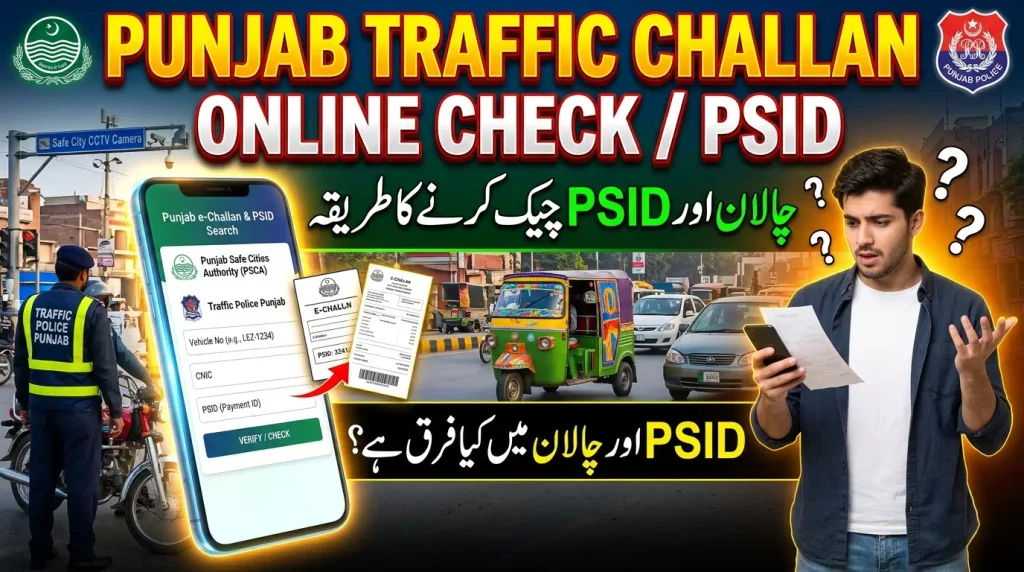
This guide explains traffic challan psid check online step by step, including what a PSID means, whether you can search a Punjab e-challan directly by PSID, how to verify the original traffic record, how a PSID is generated, how official online payment works, what to do if payment does not update, and how to avoid fake PSID or challan messages. For a broader introduction to traffic fines across Pakistan, you can also visit our E-Challan Checker Pakistan guide.
What Is Traffic Challan PSID Check Online?
Traffic challan PSID check online usually describes one of two intentions. The driver either wants to find an existing traffic challan and obtain its PSID for payment, or already has a PSID and wants to understand whether it belongs to a genuine traffic fine and how it should be paid.
These two tasks should not be mixed together. Finding the original challan normally starts with the official traffic authority responsible for the violation. In the Punjab Safe Cities e-challan system, the current public search process uses the vehicle plate number together with either the owner’s 13-digit CNIC or the vehicle chassis number.
Once an eligible challan has been identified, the payment process can involve generation of a PSID. The PSID then acts as a payment reference that connects the government payment system with the amount due. This separation between “checking the challan” and “paying through PSID” is the key to understanding the entire process correctly.
What does PSID mean?
PSID stands for Payment System Identifier. ePay Punjab currently describes it as a unique 17-digit number provided after a challan or payment request is generated. It allows a government payment to be identified through supported banking and payment channels.
Think of the PSID as a payment reference rather than a vehicle registration number. It helps the payment system understand which government receipt or fine is being paid. This is why entering somebody else’s PSID or using an incorrect number can create a serious payment problem.
Can You Check a Traffic Challan Directly by PSID?
This is one of the most important questions for anyone searching traffic challan psid check online. At present, the official public PSCA e-challan search page does not show a PSID field as the main method for finding a traffic violation. Instead, its public search form requests the vehicle plate number and either the registered owner’s CNIC or the vehicle chassis number.
Therefore, you should not assume that there is a separate official Punjab website where every traffic challan can simply be searched by entering a PSID. If you need to find the original Punjab Safe City challan, start with the official PSCA E-Challan System and use the verification fields currently provided there.
If you already have a PSID, it can still be extremely important for payment and transaction records. However, a PSID should not automatically be treated as a substitute for checking the underlying traffic violation through the correct official authority.
PSID is mainly a payment reference
This distinction protects users from misleading websites. An unofficial page may claim that it can reveal every traffic record just from a PSID, but that claim should not be trusted unless the service is clearly connected to the responsible government authority.
Use the original traffic portal to verify the violation and use the PSID only through official or authorized payment channels. This two-step approach is safer than treating a payment number as proof that a challan is genuine.
How to Do Traffic Challan PSID Check Online in Punjab
The correct traffic challan psid check online process begins with verification rather than payment. First identify whether the ticket is a Punjab Safe Cities e-challan, a traffic violation ticket issued by a traffic officer, or another type of challan. The payment reference can depend on that original ticketing process.
For a relevant Punjab Safe Cities record, open the official PSCA e-challan portal. Enter the plate number exactly as required and then provide either the owner’s 13-digit CNIC or the vehicle chassis number. Once the official system returns the record, carefully review the vehicle and violation information.
Do not move directly to payment merely because a challan appears. Confirm that the vehicle registration, available violation information, fine amount, and other displayed details make sense. If the record does not appear to belong to your vehicle, use the appropriate official review or support route instead of paying first.
For additional Punjab-specific information, our E Challan Punjab guide explains the wider Punjab e-challan process and the role of official traffic services.
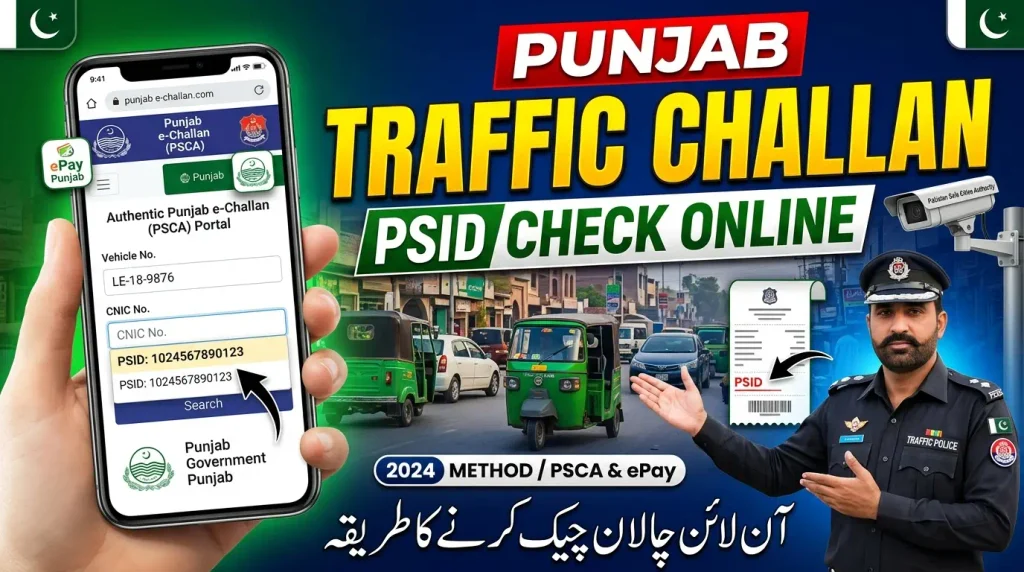
Step 1: Verify the original challan
The first step should always be confirming that the traffic fine is genuine. This is particularly important when the user first learns about the challan through an SMS, WhatsApp message, social-media post, or an unofficial website.
Open the official traffic authority independently rather than following an unfamiliar payment link. For PSCA records, use the official e-challan search page. Verification should happen before the PSID is used for payment.
Step 2: Generate or locate the PSID
After the challan is confirmed, follow the official payment flow associated with that ticket. Punjab’s published ePay guidance describes generating a challan and obtaining a PSID that can then be used for payment.
Traffic Police Punjab also states that a PSID is generated for a traffic violation ticket and can be paid online through supported mobile banking or online-wallet channels. Because the ticketing situations can differ, always use the PSID attached to the specific genuine challan you are paying.
How to Pay a Traffic Challan With PSID Online
Once you have verified the traffic challan and confirmed that the PSID belongs to that genuine record, you can move to payment through an official or supported channel. The official ePay Punjab website describes PSID-based government payments and currently identifies the PSID as a 17-digit unique number.
ePay Punjab currently lists several types of supported payment channels, including ATM, internet banking, mobile banking, mobile wallets, telecom network agents, and over-the-counter options. The exact menu wording can differ between banks and payment services, so follow the current government-payment or bill-payment interface offered by the financial service you use.
Before confirming the payment, carefully compare the details available to you with the traffic challan. Do not knowingly pay a PSID that came from an unknown person, an unofficial social-media account, or a suspicious message without first verifying the underlying traffic ticket.
After payment, save the receipt, transaction ID, date, amount, and PSID. These details are important if the payment status does not update immediately or if you later need help from the relevant traffic authority.
Why the 17-digit PSID matters
The PSID identifies a particular government payment request. Because it is a unique payment reference, accuracy is essential. A driver should copy the number carefully and verify it against the genuine traffic record or officially generated payment information.
Do not confuse the PSID with a vehicle plate number, CNIC, or traffic challan number. Those identifiers serve different purposes, even though they may all appear during the same traffic-fine process.
PSID for Traffic Police Punjab Violation Tickets
A PSID is not limited to the idea of a camera-generated Safe City e-challan. Traffic Police Punjab also publishes a process for traffic violation tickets in which a PSID is generated by the traffic officer. The official Traffic Violation Ticket guidance states that the generated PSID can be used for online payment.
This matters because users searching traffic challan psid check online may actually be holding an officer-issued traffic ticket rather than a Safe City camera challan. The two records should not automatically be assumed to have the same checking workflow.
If a traffic officer has issued the ticket and provided a PSID, keep the ticket and payment reference together. Follow the payment instructions associated with that genuine ticket and save proof after completing the transaction.
If you are unsure whether your ticket is electronic, camera-generated, or an officer-issued traffic violation ticket, our E-Challan vs Manual Challan guide explains the practical differences between common ticketing methods.
PSID vs Challan Number vs Vehicle Number
One reason people struggle with online challan checking is that several different numbers can appear during the process. Each number has its own purpose, and confusing them can lead to failed searches or incorrect payment attempts.
A vehicle registration or plate number identifies the vehicle. Punjab’s current PSCA e-challan public checker uses plate information as one of its search fields. It does not serve the same purpose as a PSID.
A challan or ticket number identifies a particular traffic violation record where such a number is provided. It can be useful when communicating with the issuing authority or referring to the specific ticket.
A PSID identifies the payment request. It is particularly important when using supported payment channels to settle the amount due. This is why the safest workflow is to identify the challan first and then use the PSID linked to that verified record.
CNIC and chassis number are different too
The current Punjab Safe Cities public e-challan checker asks for the registered owner’s 13-digit CNIC or the vehicle’s chassis number together with the plate number. These are used to help verify the vehicle-related record.
They should not be entered into an unknown website just because that website promises a fast PSID search. Identity and vehicle information should be provided only where it is genuinely required by a trusted official service.
How to Confirm a PSID Before Paying
Before using a PSID, make sure it came from the genuine traffic-ticket or government payment workflow. A number sent by an unknown person should not be trusted merely because it contains 17 digits or is accompanied by a government logo.
Start from the official challan record whenever possible. Confirm that the vehicle and traffic violation belong to you, follow the official payment flow, and use the PSID generated for that verified record.
When entering the PSID into a supported payment service, double-check every digit. Before final confirmation, review any payment information displayed by the service and make sure you are using the intended government-payment route.
After the payment is completed, do not discard the PSID. Keep it together with the payment receipt because both can be useful if the challan status remains unchanged or a payment needs to be investigated.
Paid PSID but Challan Still Showing Unpaid
A common problem after traffic challan psid check online is that a user pays the PSID but later sees the challan still appearing as outstanding. If this happens, avoid making the same payment again immediately.
First check your original transaction. Confirm whether the bank, wallet, ATM, or other payment service actually marked the transaction as successful. A pending or failed transaction is different from a successful payment.
Next, compare the PSID on the payment receipt with the PSID associated with the traffic fine. Also confirm the amount and payment date. Saving this information makes it easier to explain the issue to the relevant authority.
Government databases and payment systems may not always display updates at exactly the same moment. If a successfully paid challan continues to show an incorrect status, use the official support route and provide the relevant transaction evidence rather than attempting repeated payments.
Do not pay twice without checking
Repeated payment attempts can make a simple status delay more complicated. Always identify what happened to the first transaction before trying again.
If you need help locating the appropriate Punjab traffic contact route, our Traffic Police Punjab helpline guide provides additional contact-related guidance.
What If You Lost Your Traffic Challan PSID?
Losing the PSID does not mean that you should generate random numbers or pay through an unofficial person. Return to the original official challan source and try to locate the traffic record again using the official search method available for that type of ticket.
For a Punjab Safe Cities e-challan, begin with the official PSCA verification page and search the vehicle record using the current required details. If the official workflow allows the relevant challan or payment reference to be generated again, use that process rather than relying on a screenshot or number received from someone else.
If the PSID came from an officer-issued traffic violation ticket and the ticket information is missing, contact the responsible traffic authority using official channels and provide only the information needed for assistance.
Always keep future traffic-payment references in a secure location. A screenshot of the genuine challan, the PSID, and the final payment receipt can make later follow-up much easier.
Multiple Challans and Multiple PSIDs
A vehicle can have more than one traffic violation record. When this happens, do not assume that one payment reference automatically clears every outstanding challan. Each traffic record and its associated payment information should be reviewed carefully.
The safest approach is to check the official challan list, identify each outstanding record, and follow the payment flow shown for the challans you actually want to settle. Keep the payment evidence organized so you can later match each transaction with the correct traffic record.
If several challans are shown, review them individually before payment. Dates, locations, violation types, and fine amounts can help you understand whether each record appears to match your vehicle history.
This is another reason why traffic challan psid check online should not be reduced to simply copying a PSID into a payment app. Verification of the original records should come first.
Wrong PSID or Wrong Payment Reference
If you have not yet paid and notice that the PSID appears incorrect, stop before confirming the transaction. Return to the official traffic record and obtain the correct payment information. Do not try different PSIDs until one appears to work.
If a payment has already been made against the wrong reference, keep all transaction evidence. The issue may need to be reviewed by the relevant payment service or traffic authority, depending on how and where the transaction was made.
Do not delete receipts even when a payment mistake occurs. The PSID, transaction ID, date, time, amount, and payment channel are useful pieces of information for explaining what happened.
Most importantly, do not send additional money to a private person who claims they can “correct” the PSID or remove the challan. Use recognized government and payment-service channels for legitimate corrections.
How to Avoid Fake PSID Challan Messages
Traffic fines create urgency, which makes them attractive to scammers. A fake message may claim that a challan must be paid immediately and may provide a payment link, account number, wallet number, or supposed PSID.
Do not treat the presence of a PSID-like number as proof that the message is genuine. A scammer can easily type a long number into a message. Verification through the actual traffic authority is what matters.
For a Punjab Safe Cities record, independently open the official PSCA e-challan portal rather than clicking an unfamiliar link. Search the vehicle using the fields provided by the genuine government service and confirm whether the alleged challan actually exists.
Never send your banking password, ATM PIN, card CVV, or OTP to anyone who claims they need it to verify or pay a traffic challan. Those credentials should remain private.
Verify first, pay second
This simple rule prevents many avoidable problems. Confirm the traffic violation through the correct authority, confirm the payment reference, and only then complete the official payment process.
A message itself is not the government traffic database. Independent verification gives you a much stronger basis for deciding whether payment is actually required.
PSID Challan Check for a Used Vehicle
Traffic challan verification can also be useful when buying or selling a used vehicle. However, a PSID by itself should not be treated as a complete history of every traffic fine connected with a vehicle.
Before completing a purchase, check available traffic records through the appropriate official authority and make sure ownership information is handled correctly. If a pending challan appears, discuss the record with the seller before completing the transfer.
If an official search requires registered-owner information, the legitimate owner should participate in the verification. Do not try to obtain another person’s CNIC or private identity information through unofficial means.
A used-vehicle check should also include proper vehicle-registration and ownership verification. Traffic challan information is useful, but it is only one part of checking a vehicle before purchase.
Common Traffic Challan PSID Check Online Mistakes
A common mistake is believing that PSID is the universal search number for every traffic challan in Pakistan. Payment systems and traffic authorities can differ, and the Punjab Safe Cities public checker currently uses vehicle plate information plus CNIC or chassis details rather than a PSID search box.
Another mistake is paying before verifying the traffic violation. The correct order is verification first and payment second. This prevents users from paying a fake demand or a reference that does not belong to the expected vehicle.
Typing the PSID incorrectly can also create confusion. Copy all digits carefully and use the exact reference generated through the genuine workflow. Do not rely on a handwritten number if a clearer official digital record is available.
Finally, many people forget to save payment proof. Keep the PSID and receipt even after the transaction succeeds. These records can be valuable if the challan continues to appear as unpaid or if you need assistance later.
Traffic Challan PSID Check Online FAQs
Final Thoughts
Traffic challan PSID check online becomes much easier once you understand that challan verification and PSID payment are two related but different steps. The current Punjab Safe Cities public checker uses the vehicle plate number together with CNIC or chassis information to locate relevant e-challan records, while the PSID is used as a payment identifier in the official Punjab payment workflow.
Always verify the actual traffic violation before paying. If the challan belongs to the PSCA system, start with the official e-challan portal. If it is an officer-issued Traffic Police Punjab violation ticket, follow the genuine ticket and its PSID payment instructions. Do not assume that every long number received by SMS is an authentic government payment reference.
When payment is completed, keep the PSID, transaction receipt, amount, and date together. If the challan remains unpaid online, check the original transaction before paying again and use the official authority’s support process when necessary.
For more help understanding Pakistan’s different traffic challan systems, you can return to EChallanChecker.online. The website is an independent informational resource and does not issue, cancel, modify, or collect government traffic challans.