
E Challan vs Manual Challan Dispute Guide in Pakistan 2026
Two vehicles get pulled over for the same violation on the same road, but one driver gets a paper slip from a traffic warden. The other never sees an officer at all, just an SMS a few hours later. Both are called a “challan” in Pakistan, but they are generated differently, carry different evidence, and are disputed differently.
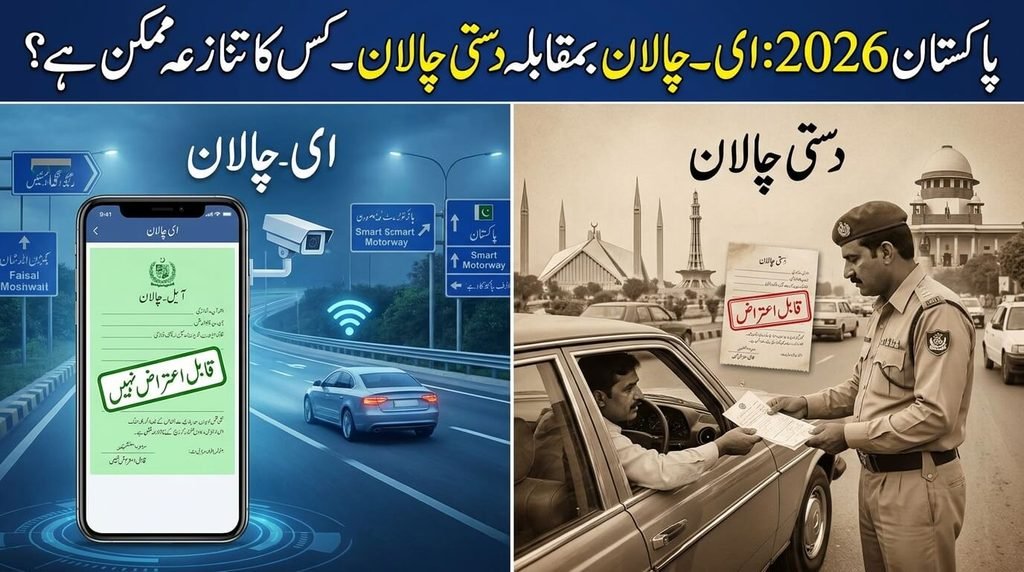
Understanding which one applies to you changes how you check it, how fast you find out about it, and how you should respond. This guide breaks down E Challan vs Manual Challan in Pakistan, how each system works, where each is still used, and which one holds up better if you decide to dispute it. By the end, you should have a clear understanding of how the two types of challans differ and what to check if you receive one.
E-Challan vs Manual Challan: Quick Comparison
Both types of citations serve as official traffic violation records, but their operational parameters and execution frameworks differ significantly across multiple touchpoints:
| Factor | E-Challan | Manual Challan |
|---|---|---|
| How it’s issued | Automatically by ANPR/Safe City cameras or a warden’s handheld digital device. | Face-to-face by a traffic warden who stops the vehicle. |
| Evidence | Timestamped photo or video, GPS location, plate-recognition match. | Officer’s written note and personal observation. |
| Where it’s common | Punjab and Islamabad. | Sindh, KPK, and Balochistan, especially outside major cities. |
| Notification | SMS to the registered mobile number (not guaranteed to arrive). | Handed to the driver immediately on the spot. |
| Payment | JazzCash, EasyPaisa, internet banking, ATM, or official portal, all using the PSID. | Historically required a bank branch; officers are not authorized to accept cash on the spot. |
| Dispute process | Online, through the official portal’s dispute or review section. | Often depends on officer testimony and in-person appeal. |
| Legal validity | Issued through an electronic system, with supporting digital evidence where available. | Recorded as a traffic violation, with the available evidence depending on how the challan was issued. |
How an E-Challan Is Issued
One important difference is the type of evidence available when a challan is disputed. Where automated enforcement is used, a camera system can record a violation without a traffic warden being present at the scene. An ANPR (Automatic Number Plate Recognition) system may read the vehicle’s registration number and use available vehicle records to identify the relevant vehicle.
The resulting challan can contain details such as the violation, date, time, location, available image evidence, and a payment reference. For information about Punjab’s Safe Cities and electronic traffic-enforcement services, see the official Punjab Safe Cities Authority website. Automated challans rely on the information captured by the camera system and the records connected to it. If a driver believes the challan is incorrect, the available image, vehicle details, date, time, and location can be checked as part of the review process.
How a Manual Challan Is Issued
A manual challan is issued when a traffic officer observes a violation and records the relevant details. It may be written on a paper challan or entered through a handheld device, depending on the system used by the authority. Manual enforcement is still used in areas where electronic traffic-enforcement services are limited or not available.
One detail worth knowing: Payment should be made through the method specified by the issuing authority. Do not hand cash directly to a traffic officer unless the authority’s published procedure specifically permits it. If a warden asks for cash directly, that is not a legitimate manual challan payment and should be treated as a red flag.
Evidence and Disputes: Where the Real Difference Shows Up
Both are forms of traffic-violation records, but the way they are issued and the evidence available with each can be different. The practical difference shows up when you try to dispute one.
An e-challan’s dispute usually comes down to reviewing the photo or video evidence attached to the record: was the plate read correctly, was the vehicle actually yours at that location and time, and does the timestamp match your account. This evidence is stored centrally and can be requested through the official portal’s dispute or complaint section, in Islamabad and Punjab in particular, where the process is largely online.
In a manual-challan dispute, the available evidence may include the officer’s record, the details written on the challan, and any supporting material provided by the driver. The exact review process depends on the issuing authority. This evidence gap is the single biggest factor separating E-Challan vs Manual Challan outcomes when a case is contested. If you believe a challan is incorrect, check the issuing authority’s dispute procedure before making payment. The effect of payment on a dispute can depend on the applicable rules.
Practical Steps for Disputing a Challan
Disputing an E-Challan
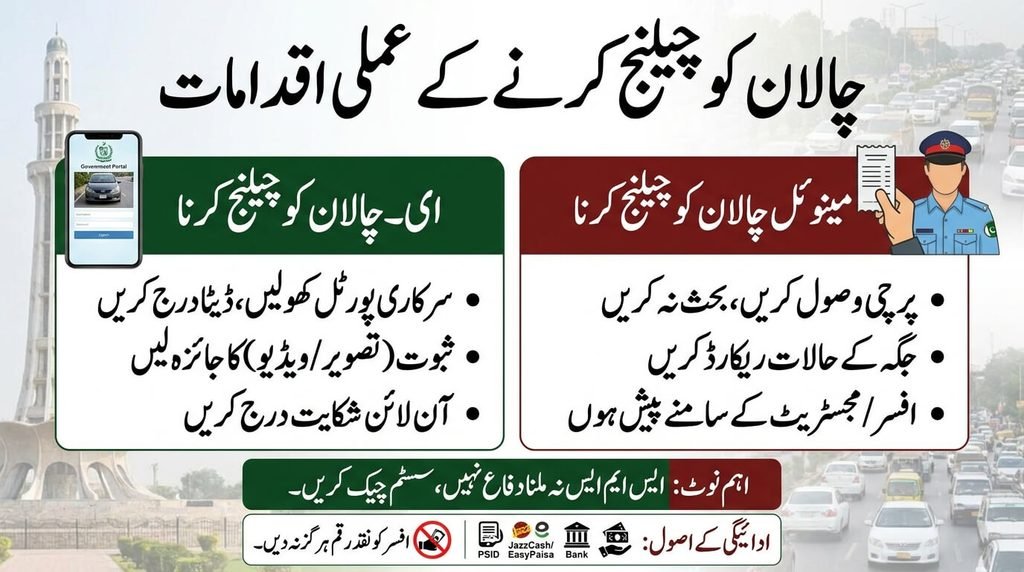
- Open the official provincial traffic portal (such as PSCA for Punjab or ITP for Islamabad).
- Enter your vehicle registration number and CNIC to pull up the recorded citation.
- Review the attached photographic and video evidence to check for misread number plates.
- Submit a formal dispute through the portal’s complaint section with supporting documents.
- Retain the complaint tracking number until the review committee updates the status.
Disputing a Manual Challan
- Receive your copy of the paper challan slip without road confrontation.
- Document any relevant road conditions, signage, or physical markers at the location.
- Present your case before the designated Sector Officer or DSP Traffic during working hours.
- Provide your supporting documentation alongside the issued citation memo.
- If unresolved administratively, appear before the Traffic Magistrate for judicial adjudication.
Why “I Never Got an SMS” Isn’t a Valid Defense
Some e-challan systems use SMS or other notifications to inform the registered owner about a violation, but SMS delivery is not guaranteed. Outdated numbers in NADRA or Excise records, network issues, or simple delivery delays mean the message doesn’t always arrive. Not receiving an SMS does not necessarily mean that no challan was issued. The safest way to confirm a record is to check the relevant official traffic system rather than relying only on an SMS notification.
Be cautious of any SMS containing a payment link, regardless of how official it looks. This is a common scam pattern. A manual challan, by contrast, is handed to the driver in person at the time of the violation. There’s no notification gap, since the driver already has the paper slip in hand.
Payment Rules and Restrictions
Payment options depend on the issuing authority and the type of challan. Where a PSID or other payment reference is provided, use the payment channels listed by the official traffic authority. Follow the payment method specified by the issuing authority. Do not hand money directly to a traffic officer unless the authority’s published procedure specifically permits it.
- JazzCash, EasyPaisa, and internet banking via the 17-digit PSID for digital fines.
- Authorized 1Link ATM machines and official portal payment gateways.
- Designated bank branches for manual challan book receipts.
- Zero cash acceptance by on-duty traffic wardens roadside.
Which System Does Your Province Use?
Coverage still varies significantly by province and even by city. The balance between automated camera networks and manual enforcement reflects regional infrastructure:
| Province / Region | Enforcement System | Coverage Detail |
|---|---|---|
| Punjab | PSCA Digital Services | Digital traffic-enforcement services are available through the Punjab Safe Cities Authority and relevant traffic authorities. |
| Islamabad | ITP Safe City | Islamabad Traffic Police provides digital traffic-enforcement and e-challan services. |
| Sindh | TRACS & Manual Wardens | Traffic enforcement uses both digital and manual methods, depending on the area and available services. |
| KPK | Hybrid Enforcement | Traffic enforcement can involve both electronic and manual processes. |
| Balochistan | Primarily Manual | Traffic enforcement may include manual processes alongside available digital services. |
Consequences of Ignoring Either Type
Both types of challan should be checked and resolved according to the instructions of the issuing authority. An unpaid challan may remain outstanding in the relevant traffic or vehicle record. The way it is linked to an owner, vehicle, or licensing record depends on the authority and applicable system. This can affect vehicle transfer, token tax renewal, and driving license renewal down the line.
Frequently Asked Questions
Conclusion
An e-challan and a manual challan differ mainly in how the violation is recorded, what evidence is available, and how the record can be reviewed or disputed. If electronic enforcement is used in your area, check the relevant official portal when you need to verify a traffic record rather than relying only on an SMS notification. If you’re in a province where manual enforcement is still common, keep any paper challan you receive and understand that the officer’s account carries real weight in a dispute. If you receive a challan, review its details and follow the payment or dispute procedure provided by the issuing authority. Keep your receipt or reference number after resolving the matter.
6 Comments