
E Challan Pakistan 2026 – Complete Guide to Traffic Fines
If you drive a car, motorcycle, or any other vehicle in Pakistan, you may have come across the term E Challan Pakistan. With traffic enforcement becoming increasingly digital, many traffic violations are now recorded electronically instead of relying only on traditional paper challans.
An e-challan in Pakistan is a digital record of a traffic violation along with the fine associated with it. Depending on the city, province, and traffic authority, drivers may be able to check their challan online, view details about the violation, see available evidence, check the payment status, and pay the fine through an online service.
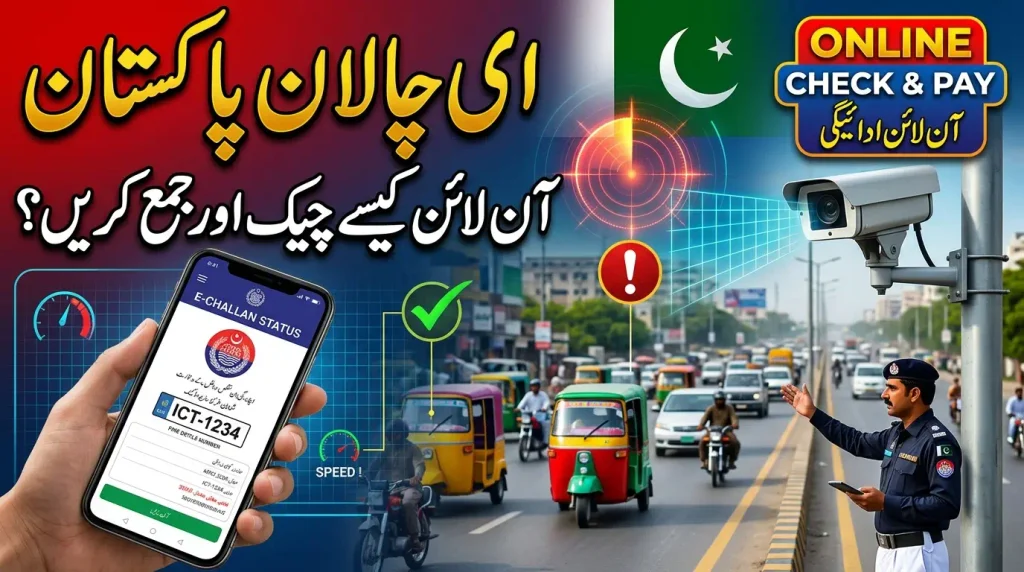
In this guide, you will learn what an e-challan is, how the e-challan system works in Pakistan, how traffic violations are recorded, what information appears on an e-challan, which authorities manage these systems, and what happens if a challan remains unpaid.
What Is an E-Challan in Pakistan?
An e-challan is the digital form of a traffic challan. Instead of keeping the violation record only on paper, the information is entered into an electronic system where it can be stored, processed, and retrieved.
A traffic violation may involve speeding, jumping a traffic signal, riding without a helmet, or another violation covered by the applicable traffic rules. Depending on the system, the violation can be detected automatically by a traffic camera or directly observed by a traffic warden.
Once the violation is recorded, the relevant information may be added to the traffic authority’s digital system. An e-challan record can contain information such as:
- Vehicle registration number
- Type of traffic violation
- Date and time of the violation
- Location where the violation occurred
- Fine amount
- Challan reference number
- Available photo or video evidence
- Payment status
One of the main advantages of an electronic record is that drivers may be able to access their challan information through an online service rather than depending entirely on a physical document.
It is important to remember, however, that Pakistan does not have one single e-challan system covering every traffic violation nationwide. Different authorities manage traffic enforcement in different areas.
Why Was the E-Challan System Introduced in Pakistan?
The move from paper-based challans to digital traffic records was intended to address several practical problems associated with traditional record keeping.
Paper records can be lost, damaged, misplaced, or difficult to retrieve. Digital records allow authorities to store traffic violation information electronically and retrieve it more easily when needed.
Online traffic services can also make the process more convenient for drivers. Where digital verification and payment services are available, a driver may be able to check a challan without visiting a traffic office simply to find out whether a fine has been issued.
Main Reasons for Using Digital Challans
Some of the key reasons for introducing digital challan systems include:
- Easier storage of traffic violation records
- Faster retrieval of challan information
- Reduced paperwork
- More organized traffic records
- Convenient online verification where available
- Easier access to violation details
- Digital payment options where supported
- Better tracking of outstanding traffic fines
- Availability of photographic evidence for certain violations
Digital traffic enforcement has been introduced at different times by different authorities. Because of this, the features available today can vary depending on the province, city, and traffic department.
How Does the E-Challan System Work in Pakistan?
An e-challan can generally be generated in two main ways.
The first method is through camera-based or automated traffic enforcement. The second involves a traffic warden who observes a violation and records it digitally.
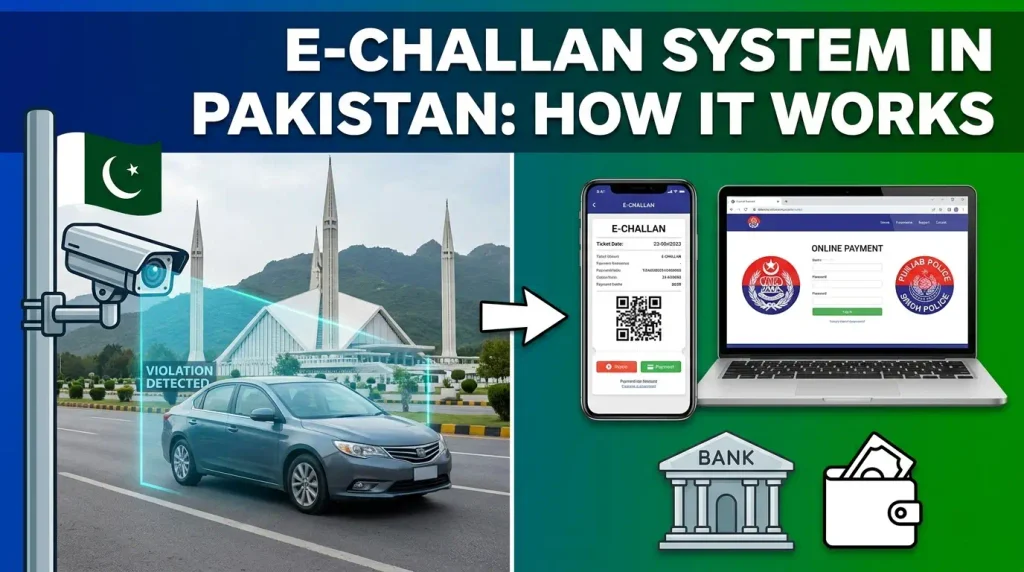
Although both methods can result in an electronic challan, the way the violation is detected and recorded is different.
How Camera-Based E-Challans Are Generated
Automated traffic cameras can identify certain violations without requiring a traffic warden to stop the vehicle at the location.
When a camera records a possible violation, the system may capture an image of the vehicle. Depending on the technology being used, the vehicle’s registration number can then be identified from the available image.
The vehicle information may be matched with available registration records to identify the relevant registered vehicle or owner.
A camera-based e-challan may include:
- Vehicle registration number
- Traffic violation
- Date and time
- Location or camera point
- Fine amount
- Challan reference number
- Photo or video evidence, where available
- Payment status
Where notification services are available, the registered owner may also receive an SMS or another notification.
The exact process depends on the traffic authority and technology being used in that particular area.
How Warden-Issued E-Challans Work
Not every e-challan is generated automatically.
A traffic warden can observe a violation directly and enter the information into a digital device such as a handheld terminal, tablet, or other authorized system.
The process may involve the following steps:
- A traffic warden observes a traffic violation.
- The vehicle is stopped when required.
- The warden records the violation details.
- The information is entered into a digital device.
- A digital receipt may be generated.
- The receipt may contain a challan number or QR code.
- The violation is entered into the relevant traffic system.
- The record may later become available through the applicable online service.
This type of challan can be described as a manual-to-digital process because the violation is observed by a person, while the record is created electronically.
A recently issued challan may not always appear online immediately. There can be a delay between the time the violation is recorded and the time the information becomes visible in the digital system.
If a new challan is not showing online, checking again later or contacting the relevant traffic authority may be necessary.
How Does the E-Challan System Work in Pakistan? Information Does an E-Challan Contain?
An e-challan normally contains information that identifies the vehicle, explains the violation, and records the associated fine.
The exact information can vary depending on the authority and type of violation, but a typical e-challan may include the following:
| E-Challan Information | What It Means |
|---|---|
| Challan Reference Number | A unique number used to identify and track the challan |
| Vehicle Registration Number | The registration or plate number associated with the vehicle |
| Violation Type | The traffic rule or violation recorded |
| Date and Time | When the violation was recorded |
| Location | The location or camera point, where available |
| Fine Amount | The applicable penalty in Pakistani rupees |
| Photo or Video Evidence | Available digital evidence, mainly for camera-based violations |
| Payment Status | Shows whether the challan is pending, paid, or disputed |
Challan Reference Number
The challan reference number is used to identify a particular traffic violation. It can be important when checking the record or making a payment.
Vehicle Registration Number
The registration number connects the traffic violation with the relevant vehicle record.
Violation Details
The violation section explains the reason for the challan. Depending on the situation, it may relate to speeding, a traffic signal violation, helmet requirements, or another traffic rule.
Date, Time, and Location
These details provide information about when and where the violation was recorded. For camera-based enforcement, the location may refer to the camera point.
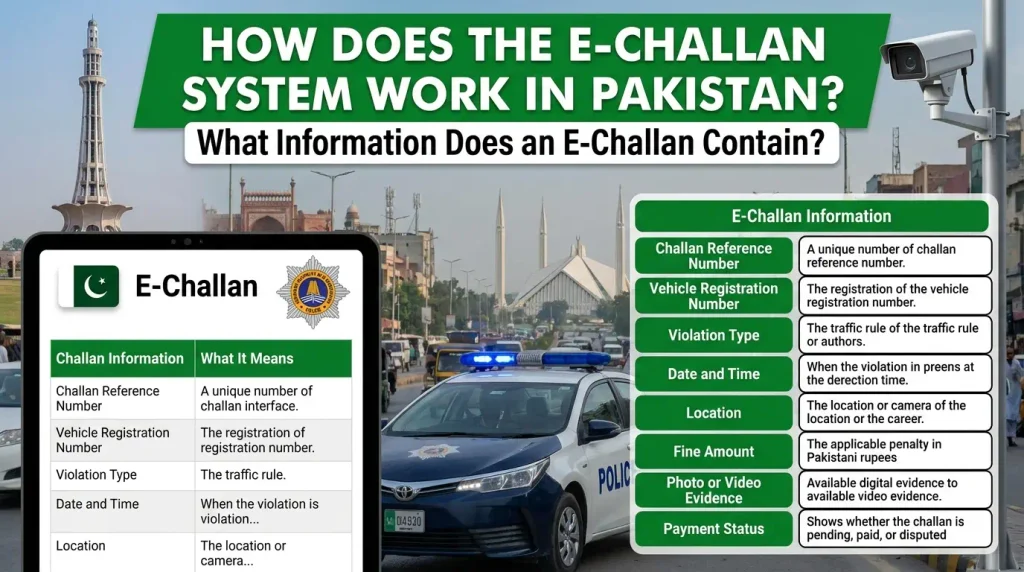
Photo or Video Evidence
Some camera-based e-challans may contain photographic or other digital evidence. The availability of evidence depends on the system used by the relevant authority.
Which Authorities Manage E-Challans in Pakistan?
E-challan services in Pakistan are managed by different authorities rather than one single nationwide system.
The relevant authority depends on where the traffic violation occurred and which department issued the challan.
| Area | Relevant Authority |
|---|---|
| Punjab | Punjab Safe Cities Authority and relevant Punjab traffic authorities |
| Islamabad | Islamabad Traffic Police |
| Sindh | Relevant Sindh traffic authorities |
| Khyber Pakhtunkhwa | Relevant KP traffic authorities |
| Balochistan | Relevant Balochistan traffic authorities |
| National Highways | National Highway & Motorway Police |
Because these systems are operated separately, checking one e-challan system may not show a record issued by another authority.
For example, a traffic violation issued by one city’s traffic department may not appear when a driver checks a different province’s traffic system.
This is why it is important to identify the authority that issued the challan before checking its status.
What Are the Benefits of the E-Challan System?
Digital challan systems can provide several benefits for both traffic authorities and vehicle owners.
For authorities, electronic records can make it easier to store, organize, and retrieve traffic violation information. For drivers, online services can provide a more convenient way to check available challan details.
Main Benefits of E-Challans
Some of the main benefits include:
- Faster processing of traffic violations
- Reduced paperwork
- Less manual record keeping
- Easier access to challan information
- Convenient online verification where available
- Better organization of traffic records
- Digital payment options where supported
- Improved tracking of outstanding fines
- Better identification of repeated traffic violations
- Easier access to available digital evidence
Digital systems can also help traffic authorities maintain more organized records over time.
As digital traffic enforcement continues to expand, e-challans are becoming an increasingly important part of traffic management in areas where these systems are available.
What Happens If an E-Challan Is Not Paid?
An unpaid e-challan may remain outstanding in the relevant traffic system. Depending on the authority and applicable rules, an outstanding fine can become relevant during certain vehicle or licensing-related services.
Possible consequences may include:
- Additional charges where applicable
- Delays during certain vehicle-related services
- Additional verification requirements
- Issues during ownership-transfer processes
- Further action under applicable traffic rules
The consequences are not necessarily identical throughout Pakistan. Different traffic authorities may follow different procedures and rules.
For this reason, drivers should not assume that an unpaid challan will automatically disappear after a certain period.
Can an Unpaid Challan Affect Vehicle Services?
An outstanding traffic fine may become relevant when completing certain vehicle-related processes.
For example, a person dealing with vehicle ownership transfer or another service may need to resolve outstanding dues before completing the process, depending on the applicable rules.
Drivers should therefore keep track of their traffic records and deal with genuine outstanding fines rather than ignoring them.
How Long Does It Take for an E-Challan to Appear Online?
A newly issued e-challan may not appear in the online system immediately.
The time required for an e-challan to become visible can depend on several factors, including:
- Traffic authority
- Location of the violation
- Type of violation
- Whether the challan was camera-generated
- Whether it was issued by a traffic warden
- Processing time
- Updates between different digital systems
A short delay does not necessarily mean that a challan does not exist.
If you have recently received a challan and cannot find it online, you can check again after some time. If the record still does not appear, contacting the relevant traffic authority can help clarify the situation.
When checking the record, pay attention to its current status. It may be shown as pending, paid, disputed, or otherwise updated depending on the system.
How to Avoid Fake E-Challan Messages and Scams
As digital traffic services have become more common, fake e-challan messages can also create problems for drivers.
A fraudulent message may claim that you have received a traffic fine and then provide a payment link. The goal may be to trick you into sending money or entering personal and financial information on a fake website.
These messages can sometimes look convincing, which is why drivers should verify traffic fines carefully.
Signs of a Suspicious E-Challan Message
Be cautious if a message:
- Comes from an unexpected or unknown sender
- Contains a suspicious payment link
- Requests sensitive banking information
- Pressures you to make an immediate payment
- Uses threatening language to create panic
- Directs you to an unfamiliar website
- Contains information that does not match your vehicle or traffic record
Do not assume that a message is genuine simply because it includes a vehicle number, fine amount, logo, or official-looking wording.
How to Verify an E-Challan Safely
If you receive an unexpected traffic-fine message, verify the challan directly through the relevant official traffic authority.
Avoid using payment links contained in suspicious or unexpected messages.
Before making any payment, check:
- Whether the challan actually exists
- Whether the vehicle registration number is correct
- Whether the violation details match
- Whether the fine amount is correct
- Whether the payment service belongs to the relevant authority
After paying a genuine challan, keep the payment receipt and reference number for your records.
What Should You Do After Receiving an E-Challan?
If you receive an e-challan, the first step is to verify the information.
Do not immediately assume that every message or notification claiming to be a traffic fine is genuine. Confirm the record through the relevant authority.
Once the challan is verified, review the violation details carefully.
Check the:
- Vehicle registration number
- Violation type
- Date and time
- Location
- Fine amount
- Available photo or video evidence
- Payment status
If all the information is correct and the challan is genuine, follow the payment instructions provided by the relevant authority.
If you believe the challan is incorrect, check whether the issuing authority provides a dispute or review process.
Keeping a record of your payment or dispute can also be useful later.
Frequently Asked Questions About E-Challan Pakistan
No. Digital traffic enforcement has been introduced by different authorities at different times. The availability and features of e-challan systems can therefore vary between cities and provinces.
Important Things to Know About E-Challans in Pakistan
There are several points drivers should remember when dealing with e-challans.
First, there is no single process that applies identically across all of Pakistan. Different authorities operate different systems.
Second, checking one online traffic system may not reveal a challan issued by another authority. Always identify the department responsible for the violation.
Third, newly issued challans may take some time to appear online. A delayed record does not necessarily mean that the violation has been cancelled.
Fourth, drivers should be particularly careful with unexpected SMS messages and payment requests. Fake e-challan scams can use convincing information to make fraudulent requests appear genuine.
Finally, keep your payment receipt or reference number after settling a genuine traffic fine. This can provide useful proof if you need to confirm the payment later.
E-Challan and Digital Traffic Enforcement in Pakistan
The e-challan system is part of a broader move toward digital traffic enforcement.
Traditional traffic enforcement depended heavily on physical documents and manual record keeping. Digital systems allow authorities to record information electronically and, where supported, provide online access to drivers.
Camera-based systems can also reduce the need for a traffic warden to be physically present at every location where a violation occurs.
At the same time, digital systems require accurate vehicle records, reliable technology, proper processing, and clear procedures for drivers who want to verify or dispute a violation.
This is why the experience of using an e-challan system can differ from one location to another.
Final Thoughts on E-Challan Pakistan
An e-challan in Pakistan is essentially a digital record used to document and manage a traffic violation. It can be generated through an automated camera system or created when a traffic warden records a violation using a digital device. Depending on the authority, an e-challan may include the vehicle registration number, violation type, date, time, location, fine amount, available photo or video evidence, and payment status.
The system is not identical across Pakistan because different provinces, cities, and traffic authorities manage their own traffic enforcement systems. If you receive an e-challan, identify the authority that issued it and verify the record through its official service. Check the violation details carefully before making any payment, and keep your payment receipt or reference number afterward.
You should also remain cautious about unexpected e-challan messages. Never provide sensitive financial information through an unverified payment page, and do not assume that a message is genuine simply because it looks official. Understanding how e-challans work can make it easier to check traffic records, deal with genuine fines, recognize suspicious messages, and keep your vehicle-related records up to date.