Traffic Laws in Pakistan: Rules, Fines, Licenses & E Challan
Traffic laws in Pakistan cover more than fines and penalties. Drivers and riders should know key rules for licenses, registration, speed limits, signals, lanes, overtaking, helmets, seat belts, mobile phones, parking, and safe driving. Following these rules helps prevent violations and promotes safer roads.
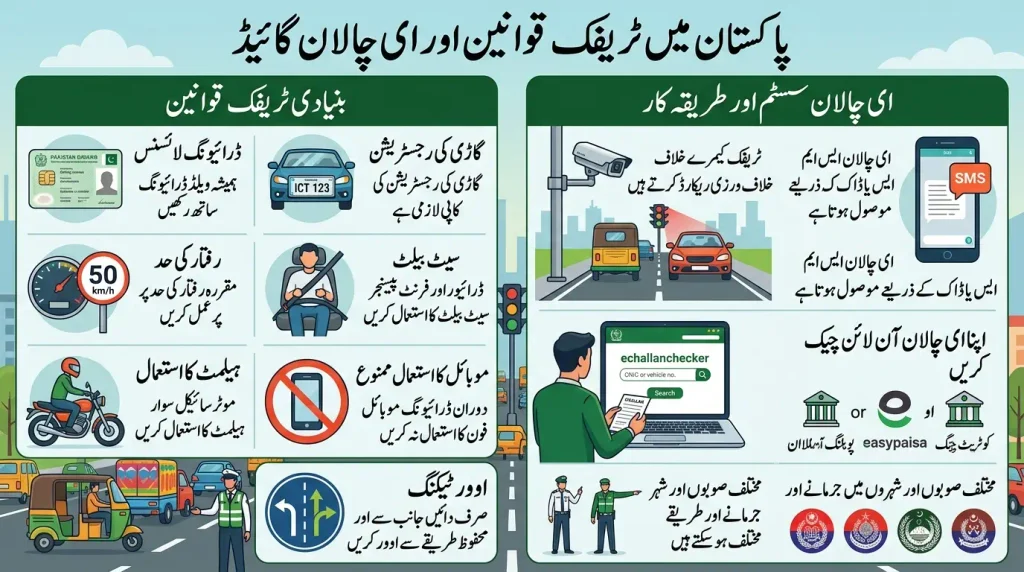
echallanchecker is here to provide you Traffic laws in Pakistan explain what may happen when a driver or rider violates a road rule. In many areas, electronic systems can detect certain violations and issue digital traffic tickets or e-challans. However, enforcement procedures can differ between provinces, cities, and traffic authorities. Fine amounts, ticket-checking methods, payment options, complaint procedures, and responsible authorities may also vary by location. Drivers should therefore follow the procedure used by the relevant traffic authority when checking or resolving a traffic ticket.
Traffic Laws in Pakistan at a Glance
Traffic laws in Pakistan cover several areas that affect drivers every day. A driver needs a valid license for the vehicle category being driven. The vehicle also needs the registration required by the relevant authority. In addition, drivers must follow posted speed limits, traffic signals, lane rules, parking restrictions, and other road-safety requirements.
Motorcycle riders and pillion passengers should follow the applicable helmet requirements. Car occupants should use seat belts whenever required. Drivers should also avoid mobile phone use while driving because it can create distraction and may constitute a traffic offence under applicable rules.
Driving under the influence of alcohol or drugs that affect driving ability is also prohibited under applicable traffic laws. Parking must follow the restrictions displayed for the location. These basic rules form an important part of responsible road use.
Driving Licence Requirements
A valid driving licence is one of the most important requirements for anyone who drives a motor vehicle on a public road. The licence should cover the category of vehicle that the driver is operating. A person should not assume that a licence for one type of vehicle automatically covers every other vehicle category.
Licensing procedures can include different requirements depending on the relevant province or territory. These requirements may include a learner permit, a driving test, supporting documents, and other conditions before a full licence is issued.
Age requirements and licence categories can also vary between jurisdictions. Therefore, anyone applying for a new licence should check the current requirements of the responsible licensing authority before starting the application.
Existing licence holders should also pay attention to the validity of their licence. If renewal becomes necessary, the driver should follow the applicable renewal procedure instead of continuing to drive with an invalid document.
Keeping the required licence available while driving is also important. A traffic officer may request the documents required under the applicable rules. Drivers should provide the required documents when requested.
Why Your Licence Category Matters
A driving licence is not simply a document that allows a person to drive. The category shown on the licence is also important. Drivers should make sure that the category matches the vehicle they are operating.
This point becomes especially important for people who drive different types of vehicles. A driver should check the applicable category rather than assuming that previous driving experience is enough.
Understanding licence requirements before driving can prevent avoidable problems. It also helps drivers prepare the correct documents when applying, renewing, or dealing with a traffic authority.
Vehicle Registration and Required Documents
A vehicle used on public roads must have the registration required by the relevant authority. In Pakistan, vehicle registration is handled through the applicable provincial system. Drivers should keep the documents required for their vehicle and jurisdiction available when travelling.
Document requirements can differ depending on the vehicle and location. Therefore, drivers should check the requirements that apply to their own vehicle instead of relying on information intended for another jurisdiction.
When a traffic officer asks for a driving licence or vehicle documents, the driver should provide the documents required under the applicable rules. Keeping documents organised can make a traffic stop easier and can also help the driver confirm that the vehicle information is correct.
Vehicle information can also become important when dealing with an electronic traffic record. Some e-challan systems use vehicle information when identifying a traffic violation. For that reason, drivers should carefully review the vehicle details shown on a traffic record.
Speed Limit Rules in Pakistan
Speed limits are an important part of traffic laws in Pakistan. The applicable limit depends on the road and the traffic authority responsible for that location. A motorway, highway, and city road may have different speed restrictions.
Drivers should always pay attention to the speed limit displayed on road signs. A general speed figure should not be used when a lower limit is specifically posted for the road being used.
Speed should also be adjusted according to road conditions. Busy intersections, residential areas, schools, hospitals, and other locations can require extra attention because traffic conditions can change quickly.
Following the speed limit should not depend on whether a traffic camera is visible. Drivers are responsible for following the applicable restriction throughout their journey.
Traffic Signals and Right of Way
Traffic signals help control the movement of vehicles at intersections and other busy locations. Drivers should understand the meaning of each signal and respond according to the road situation.
A red signal means the driver should stop completely. A yellow signal means the driver should prepare to stop when it is safe to do so. A green signal allows traffic to proceed when the way is clear.
A green light does not mean that drivers should move without checking their surroundings. Drivers should still watch for pedestrians, motorcycles, vehicles, and other road users.
At intersections without a working signal, drivers should follow applicable right-of-way rules and the directions of authorised traffic personnel. A traffic warden’s lawful hand signal can take priority when the officer is controlling traffic.
Ignoring a red light or traffic warden’s direction can result in a traffic violation. In areas where camera enforcement operates, certain signal violations may also be recorded electronically.
Lane Discipline and Overtaking Rules
Lane discipline makes traffic more predictable. Drivers should stay within marked lanes and change lanes only when it is safe. Before moving into another lane, the driver should check the surrounding traffic and use the indicator.
Indicators communicate a driver’s intention to other road users. However, using an indicator does not automatically make a lane change safe. The driver must still check mirrors, surrounding vehicles, and available space.
Sudden lane changes can create problems in both city traffic and high-speed traffic. The risk can become greater on motorways because vehicles may be travelling at higher speeds.
Safe Overtaking Practices
Overtaking should only take place when it is safe and permitted. Under ordinary traffic conditions, overtaking is generally expected from the right side. Drivers should avoid unsafe undertaking or passing from the left where applicable rules restrict such movement.
Before overtaking, a driver should check the road ahead, surrounding traffic, mirrors, and available space. The manoeuvre should not begin unless the driver can complete it safely.
Sudden overtaking can become dangerous when another vehicle is approaching, when visibility is limited, or when traffic is changing lanes. Drivers should therefore make their intentions clear and follow road markings and traffic restrictions.
Seat Belt and Helmet Rules
Seat belts and helmets are important parts of road safety. Car occupants should use seat belts whenever required. Drivers should also make sure that passengers follow the applicable requirements.
Motorcycle riders and pillion passengers should wear the required protective helmet. A motorcycle rider should make helmet use part of every journey instead of wearing one only when enforcement is visible.
Seat-belt and helmet requirements can depend on the applicable rules, vehicle type, and location. Drivers should therefore follow the requirements enforced by the relevant traffic authority.
A short trip does not remove the need to follow safety requirements. Drivers and riders should treat protective equipment as part of normal road use.
Mobile Phone Use and Driving Under the Influence
Mobile Phone Use While Driving
Using a mobile phone while driving can distract the driver from traffic. It can also constitute a traffic offence under applicable rules. Drivers should avoid handling or checking a phone while the vehicle is moving.
If a call needs to be made or a message needs to be checked, the driver should pull over safely at a permitted location before using the phone.
Drivers should also avoid assuming that stopping at a red light makes phone use safe or permissible. Traffic can begin moving quickly, and the driver may need to respond immediately when the signal changes.
Driving Under the Influence
Driving after consuming alcohol or drugs that impair driving ability is prohibited under applicable traffic laws. A person whose ability to drive safely is affected should not operate a motor vehicle.
Impairment can affect attention, judgement, reaction, and decision-making. These abilities are important when traffic conditions change unexpectedly.
The applicable penalty depends on the governing law and circumstances of the offence. However, the basic safety principle is clear: a driver should not operate a vehicle when alcohol or drugs have affected the ability to drive safely.
Parking Rules in Pakistan
Parking rules are another important part of traffic laws in Pakistan. Drivers should park only in areas where parking is permitted. No-parking zones and other restricted locations should be avoided.
Drivers should also avoid parking in front of entrances, blocking traffic, or occupying spaces where vehicles are not permitted to stop. Improper parking can obstruct other road users and create additional traffic problems.
In some cases, a vehicle parked in a restricted location may be towed. Where electronic traffic enforcement operates, certain parking violations can also be recorded without an officer standing at the location.
Drivers should therefore pay attention to parking signs and restrictions even when no traffic officer is visible. Following the displayed rules is more reliable than assuming that parking is allowed because other vehicles are already there.
Why Correct Parking Matters
Correct parking helps keep roads clear and reduces unnecessary obstruction. A vehicle parked in the wrong location can restrict the movement of other vehicles and may create problems for pedestrians and nearby road users.
Drivers should check signs before leaving a vehicle. They should also avoid blocking entrances, traffic lanes, and other restricted areas.
Common Traffic Violations in Pakistan
Drivers can face different types of traffic violations depending on their actions and the applicable rules. Some violations relate directly to road safety, while others concern documents, parking, or traffic-control requirements.
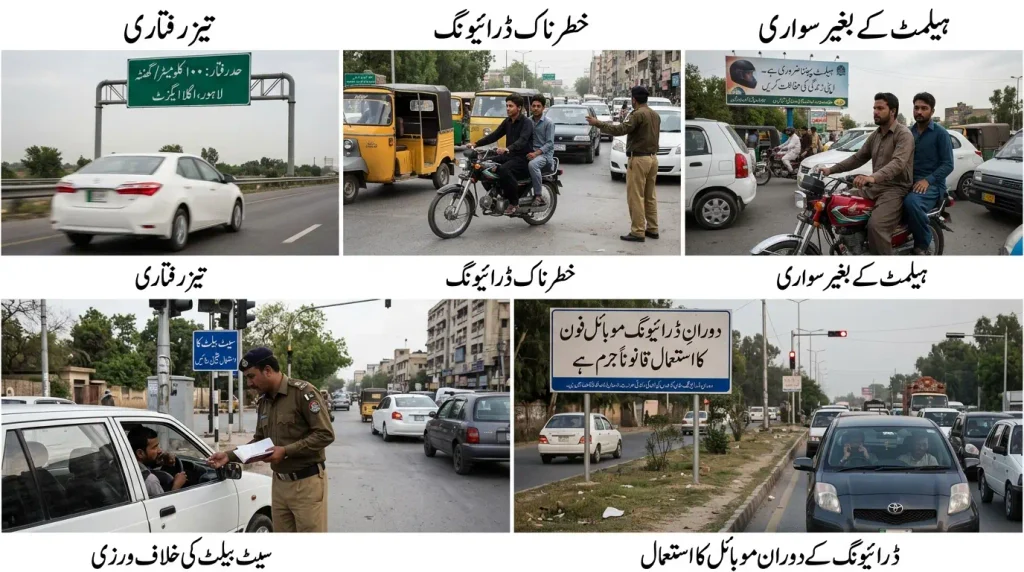
Overspeeding
Overspeeding means driving above the applicable speed restriction. Drivers should follow the speed limit displayed for the road and should pay particular attention to lower limits in school, residential, and other controlled areas.
Reckless or Dangerous Driving
Reckless or dangerous driving is treated as a traffic offence under applicable rules. Drivers should avoid sudden and unsafe manoeuvres and should operate their vehicles in a predictable manner.
No Helmet
Motorcycle riders and pillion passengers should follow the applicable helmet requirements. A protective helmet should be used on every relevant journey, not only when enforcement is visible.
No Seat Belt
Seat-belt requirements depend on the applicable rules and vehicle type. Drivers and passengers should use seat belts whenever required and should make seat-belt use part of every journey.
Mobile Phone Use While Driving
Using a mobile phone while driving can be an offence under applicable rules. Drivers should pull over safely before making a call, checking a message, or using the phone for another purpose.
E-Challan and Traffic Fines in Pakistan
An e-challan is a digital record of a traffic violation created through an electronic traffic enforcement system. Depending on the authority, a violation can be detected through a camera system or entered digitally by a traffic officer.
Electronic traffic enforcement has changed the way some violations are recorded. A driver may receive a traffic record even when an officer did not stop the vehicle at the time of the violation.
However, not every traffic authority uses the same system. Some services may use a vehicle registration number to locate a record. Other systems may require a challan number, CNIC, or another identifier.
Fine amounts can also vary according to the province, vehicle category, and type of violation. Therefore, drivers should confirm the applicable amount through the authority that issued the traffic record.
How to Check a Traffic Challan
The method for checking a traffic challan depends on the authority that issued it. Some systems allow searches using vehicle information, while others require a challan number or another identifier.
The first step is to identify the issuing authority. Once the correct system is identified, the driver can use the information requested by that authority to locate the traffic record.
After finding a challan, drivers should carefully review the available details. These details can include the vehicle information, violation, date, location, and fine amount.
Drivers should use the payment method provided by the issuing authority. A payment method used by one traffic system should not automatically be assumed to work for another authority.
Check Challan Details Before Payment
Drivers should check a traffic record before making a payment. The vehicle details should match the correct vehicle. The violation should also be reviewed so the driver understands the reason for the ticket.
The date, location, and fine amount should also be checked where those details are available. Reviewing the information can help identify an obvious error or misunderstanding before payment.
If a driver has already paid a challan, the available status information can help confirm whether the record is shown as paid, unpaid, or pending.
Be Careful With Suspicious Traffic Messages
A driver may receive a message claiming that a traffic fine is due. However, an unexpected message should not automatically be treated as genuine.
Drivers should avoid opening unknown payment links or providing sensitive information through an unverified message. Instead, the traffic record should be checked independently through the relevant authority.
The safest approach is to verify the traffic record through the authority that issued it. This helps the driver distinguish a genuine traffic record from an unverified payment request.
What to Do If You Receive a Wrong E-Challan
A driver who believes that an e-challan is incorrect should first review the information shown in the record. The vehicle details, violation, date, location, and other available information should be checked carefully.
If the information appears incorrect, the driver should check whether the issuing authority provides a complaint or dispute procedure. The process can differ between traffic authorities.
Drivers should use the procedure provided by the authority responsible for the challan. A complaint process used in one city or province should not automatically be assumed to apply in another area.
What Happens If You Do Not Pay an E-Challan?
The consequences of an unpaid e-challan depend on the authority that issued it and the rules that apply to that traffic system. Drivers should not assume that the same consequence applies throughout Pakistan.
If a driver has an unpaid challan, the current status should be checked through the issuing authority. The driver should then follow the applicable payment or dispute procedure.
Ignoring a traffic record without checking its status can leave the driver uncertain about whether the violation remains outstanding. Therefore, checking the official record is an important step.
Do Traffic Laws Differ Between Provinces in Pakistan?
Yes. Many basic road-safety requirements are similar, but traffic authorities can have different procedures, fine amounts, and local enforcement rules.
Traffic enforcement in Punjab, Islamabad, Sindh, Khyber Pakhtunkhwa, and Balochistan can involve different systems and procedures. As a result, drivers should identify the authority responsible for the location where a violation occurred.
This difference is especially important when checking e-challans. A driver should use the system associated with the authority that issued the traffic record instead of assuming that another province’s procedure will work.
The same principle applies to fine amounts and dispute procedures. Before relying on a particular amount or process, drivers should check the relevant authority.
Why the Issuing Authority Matters
The issuing authority matters because it determines which traffic system contains the record. It also determines which procedure a driver should follow when checking, paying, or disputing a violation.
For example, a driver should not use an unrelated traffic system simply because it is easier to find online. The correct authority should be identified first.
This approach also reduces confusion when different provinces use different information requirements. One authority may ask for vehicle information, while another may require a challan number or another identifier.
National Highways and Motorway Traffic Rules
The National Highways and Motorway Police, commonly known as NHMP, enforces traffic rules on motorways and national highways under its jurisdiction.
Drivers using these roads need to follow applicable speed restrictions, lane requirements, overtaking rules, and other safety requirements. Common concerns can include excessive speed, unsafe overtaking, sudden lane changes, and dangerous driving practices.
Motorway driving requires additional attention because vehicles can travel at higher speeds. Sudden lane movements can therefore create greater risks for surrounding vehicles.
For a motorway or national-highway traffic matter, drivers should use the official channels of the authority responsible for that road.
City and Provincial Traffic Enforcement
Traffic enforcement inside cities and provinces is handled by the relevant traffic police and other authorised agencies. The authority responsible for a violation depends on where the violation occurred.
City traffic systems can include both traditional enforcement and electronic enforcement. Where camera-based systems operate, certain violations can be detected and recorded without an officer stopping the vehicle at the scene.
This is one reason why drivers should understand the traffic rules that apply to their location. It also explains why e-challan procedures can differ between areas.
Practical Safety Tips for Drivers
Following traffic laws is important, but safe driving also depends on everyday habits. Drivers should make these habits part of their normal routine instead of changing their behaviour only when they see traffic enforcement.
Keep the required driving licence and vehicle documents available while travelling. Before changing lanes, check the mirrors and surrounding traffic. Use the indicator before making the movement.
Slow down near schools, hospitals, residential areas, and other locations where traffic conditions can change quickly. A driver should follow the applicable speed limit even when no traffic camera is visible.
Never drive after drinking alcohol or using drugs that impair driving ability. If driving ability is affected, the person should not operate a vehicle.
Avoid using a mobile phone while driving. Even when traffic is temporarily stopped, conditions can change quickly. Keeping attention on the road helps the driver respond to surrounding traffic.
Maintain a reasonable following distance, especially in heavy city traffic. Vehicles can slow down suddenly, and additional space gives the driver more time to react.
Safe Driving in Busy City Traffic
City traffic can change quickly because of intersections, pedestrians, motorcycles, buses, parked vehicles, road work, and other obstacles. Drivers should remain alert and avoid sudden manoeuvres.
Lane discipline becomes especially useful in crowded areas. Drivers who stay within their lane and signal before moving make their intentions easier for surrounding road users to understand.
Drivers should also avoid unnecessary weaving through traffic. Repeatedly moving between lanes can make it harder for other road users to predict the vehicle’s next movement.
Safe Driving on Highways and Motorways
Highways and motorways require careful lane management. Vehicles may be travelling faster than they do in city traffic, so sudden movements can create less time for other drivers to react.
Drivers should check mirrors before changing lanes and use indicators to communicate their intentions. Overtaking should only take place when it is safe and permitted.
Drivers should also follow posted speed limits and avoid sudden manoeuvres. Predictable driving is especially important when several vehicles are travelling close together.
Why Drivers Should Follow Road Signs
Road signs provide important instructions for specific locations. Drivers may know the general traffic rules but still need to follow a restriction displayed on the road they are using.
Speed restrictions, parking restrictions, lane information, and other instructions can be communicated through road signs. Therefore, drivers should pay attention to signs throughout their journey.
A general speed figure should not replace a lower limit that is specifically posted. Likewise, drivers should not assume that parking is permitted simply because other vehicles are parked nearby.
Documents Drivers Should Keep Available
Drivers should keep the driving licence and vehicle documents required for their vehicle and jurisdiction available while travelling. These documents can become important during a traffic stop or when dealing with a traffic authority.
The exact documentation requirements can differ according to the vehicle and jurisdiction. Therefore, drivers should confirm which documents apply to them rather than relying on assumptions.
Keeping documents organised also makes it easier to review vehicle information when a traffic record appears. If a challan is associated with a vehicle, the driver can compare the vehicle information shown in the record with the correct documents.
Traffic Laws and Responsible Driving
Traffic laws should not be viewed only as a system of fines and penalties. They also establish basic requirements for organised road use.
A valid driving licence confirms that the driver has the required authorisation for the vehicle category. Vehicle registration provides the required documentation for road use. Speed limits help control vehicle movement, while traffic signals organise movement at intersections.
Lane discipline makes vehicle movements more predictable. Helmets and seat belts provide important protective measures. Parking rules help reduce obstruction, while restrictions on mobile phone use address driver distraction.
Rules against driving under the influence address the risks that arise when a person’s ability to drive safely is affected.
Together, these requirements create a broader road-safety framework. Following them consistently helps drivers understand their responsibilities whenever they use public roads.
Frequently Asked Questions About Traffic Laws in Pakistan
Final Thoughts
Traffic laws in Pakistan are not limited to traffic fines. Drivers need to understand licensing requirements, vehicle registration, speed restrictions, traffic signals, lane discipline, overtaking, helmets, seat belts, mobile phone restrictions, parking rules, and responsible driving practices.
Electronic traffic enforcement has also made e-challans an important part of traffic management in areas where these systems operate. However, the process for checking, paying, and disputing an e-challan can vary between traffic authorities.
Drivers should therefore identify the authority responsible for a traffic matter before relying on a particular fine amount or enforcement procedure. The correct authority can provide the applicable process for that location.
The basic approach to responsible driving remains straightforward. Keep the required licence and vehicle documents available. Follow posted speed limits. Obey traffic signals. Stay within marked lanes. Signal before changing lanes. Use the required protective equipment. Avoid mobile phone distractions. Never drive while impaired. Park only where permitted.
When a traffic violation or e-challan occurs, check the record carefully. Review the vehicle details, violation, date, location, and fine information where available. Then use the procedure provided by the authority that issued the record.
Understanding traffic laws in Pakistan helps drivers know their responsibilities on public roads. More importantly, consistent compliance supports predictable and safer road use for drivers, motorcycle riders, passengers, pedestrians, and other people who share Pakistan’s roads.