
Consequences of Non-Payment of E-Challan in Pakistan: What Happens If You Ignore It?
An unpaid e-challan unpaid e-challan should not be ignored simply because you have not received an SMS or physical notice. If you believe you may have an outstanding traffic fine, check its status through the relevant official traffic authority. This can help you understand whether the challan is still pending and what action may be required.
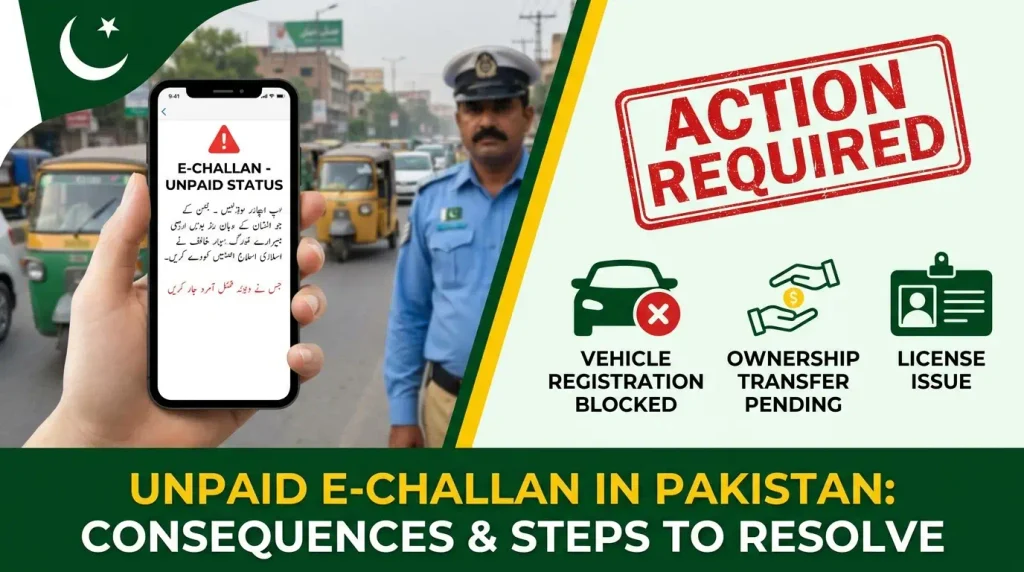
An unpaid e-challan can remain associated with the relevant vehicle or owner record until it is paid, corrected, or otherwise resolved according to the applicable procedure. Depending on the authority and the type of transaction, an outstanding challan may become relevant when you later deal with vehicle registration, ownership transfer, licensing, or another official service.
This guide explains the possible effects of leaving an e-challan unpaid, including payment delays, vehicle-related transactions, ownership issues, and other consequences that may depend on the relevant traffic authority. It also covers common situations vehicle owners face and practical steps for dealing with an outstanding challan.
How an E-Challan Stays Active Even Without an SMS
Receiving or missing an SMS does not by itself tell you whether an e-challan is outstanding. If you are unsure about a fine, check the record through the relevant official traffic authority rather than assuming that no message means there is no fine.
Where electronic enforcement is used, a camera or ANPR (Automatic Number Plate Recognition) system may record a traffic violation and generate an e-challan. Notification methods can vary, and an SMS may not always reach the registered mobile number.
Many vehicle owners may not receive an SMS because the contact information associated with their vehicle record is outdated, the registered mobile number has changed, or the available notification method does not reach them. The important point is that the absence of an SMS should not be treated as proof that no challan exists.
This is why checking the official traffic record independently can be important. If a challan has been issued electronically, its status should be confirmed through the relevant authority so that the owner knows whether payment, correction, or another action is required.
The Complete Timeline of an Unpaid Challan
Understanding the lifecycle of an e-challan helps explain why an unpaid fine can become important later. The process generally starts when a traffic violation is recorded and continues through notification, the payment period, the outstanding stage, and eventual resolution.
| Stage | What May Happen |
|---|---|
| Violation recorded | An electronic system may record the violation and generate a challan. |
| Notification | The authority may notify the registered owner through its available channels. |
| Payment period | The challan remains payable according to the terms shown by the issuing authority. |
| Outstanding period | The unpaid challan may remain on the relevant record. |
| Later verification | An outstanding challan may become relevant during certain official transactions, depending on the authority and applicable rules. |
| Resolution | The owner can pay the amount or use an available correction or dispute process if the challan is believed to be incorrect. |
The important thing to understand is that the most noticeable consequences do not necessarily happen immediately. An unpaid challan may remain in the background until the owner needs another official service. This is why someone may only discover an old outstanding fine while dealing with a vehicle sale, registration matter, licensing service, or another transaction.
Why the Timeline Matters
The timeline shows why it is better to deal with a confirmed challan instead of assuming that it will disappear on its own. The exact process, deadlines, charges, and enforcement steps can differ between authorities, so the challan itself and the issuing authority should always be treated as the primary source for the current requirements.
Immediate Effects of an Unpaid Challan
When a fine is left unpaid, several things may continue in the background. The exact effect depends on the traffic authority and the rules that apply to the particular challan, but common issues can include the following:
- Additional late fees may be added to the original fine amount where the applicable rules provide for them.
- The unpaid challan may remain visible in the relevant traffic or vehicle record until it is resolved.
- Multiple outstanding violations may require additional checking when you deal with the relevant authority.
- Depending on the applicable system, an outstanding challan may be associated with the vehicle or registered owner’s records.
- Multiple small unpaid fines can accumulate into a combined balance that becomes harder to clear at once.
For this reason, even a relatively small traffic fine should not automatically be treated as unimportant. The amount may be manageable when dealt with promptly, while several unresolved violations can create a larger outstanding balance or additional administrative work later.
Long-Term Consequences of Non-Payment of E-Challan in Pakistan
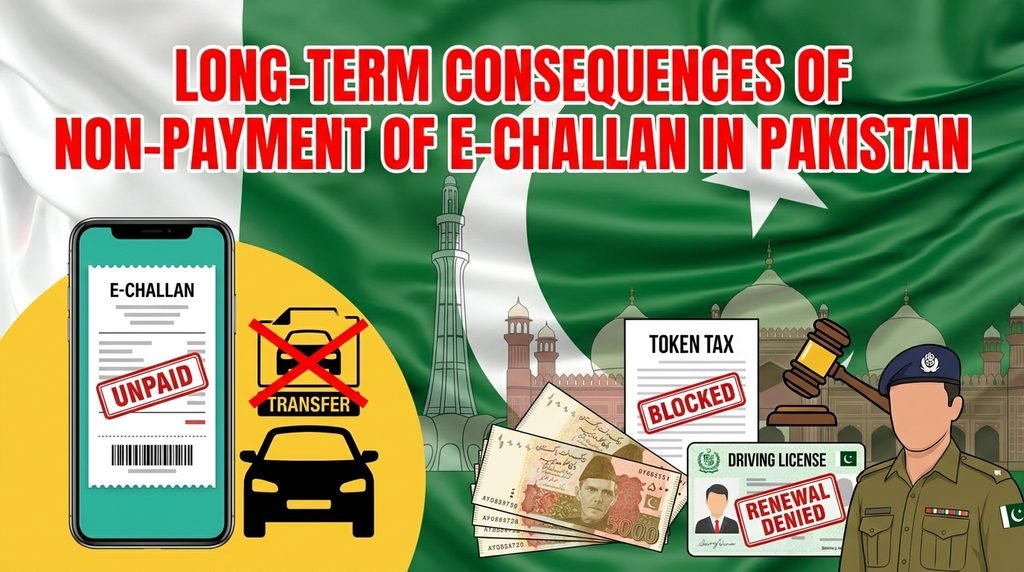
The real difficulty of ignoring a traffic fine often appears later, particularly when a vehicle owner needs to complete an official transaction. An outstanding challan may become relevant during vehicle-related services, ownership matters, or licensing procedures. The precise effect depends on the authority, province, service, and applicable rules.
1. Vehicle Ownership Transfer Issues
When a vehicle is sold, an outstanding challan may affect the ownership-transfer process if the relevant authority requires pending traffic dues to be resolved first. This means a seller or buyer may discover an unresolved fine while trying to complete the transfer.
Because requirements can change, vehicle owners should check the current requirements of the relevant Excise and Taxation Department and traffic authority before completing an ownership transfer.
2. Token Tax Renewal Issues
In some systems, outstanding traffic dues may need to be resolved before certain vehicle-related transactions can be completed. Whether this affects token tax renewal depends on the province, the vehicle service being requested, and the current rules of the relevant authority.
Therefore, vehicle owners should not assume that every province follows exactly the same procedure. If a pending challan appears during a vehicle service, follow the instructions provided by the authority handling that transaction.
3. Driving Licence Complications
Requirements for driving licence renewal or verification can vary by authority. If an outstanding challan is flagged during a licensing transaction, the driver may need to follow the instructions provided by the relevant traffic or licensing authority before the service can be completed.
4. Escalation to Legal Proceedings
Serious traffic offences can involve consequences beyond an ordinary fine under the applicable law. If an unpaid matter is accompanied by a legal notice or another formal instruction from an authority, the notice should be followed carefully. Where necessary, appropriate professional advice may also be considered.
5. Compounding Financial Burden
The longer a fine remains unpaid, the greater the possibility that the total amount may become more difficult to manage. Where applicable rules provide for late charges, additional amounts may be added. Separate traffic violations can also increase the overall outstanding balance.
The exact amount depends on the rules and payment terms applicable to the particular challan. Vehicle owners should therefore check the current outstanding amount rather than relying on an old figure or assuming that every challan follows the same fee structure.
6. Reputational and Ownership Complications
An outstanding challan may also become relevant during certain vehicle-related checks or transactions. The exact effect depends on the authority, the service being requested, and the records involved. This is another reason to resolve confirmed fines and keep ownership information properly updated.
Why the CNIC Link Makes This Harder to Escape
Vehicle ownership records are associated with the registered owner, and traffic authorities may use these records when identifying or processing challans. The exact relationship between a challan, vehicle record, and owner record can vary by jurisdiction.
This is particularly important when ownership information has not been updated after a vehicle sale. If a vehicle remains officially registered under the previous owner, later traffic records may continue to be associated with the registered record until the ownership situation is formally corrected.
For this reason, an unresolved fine should not simply be expected to disappear with time. The proper approach is to check the record, understand why the challan is showing, and use the available payment, correction, or dispute procedure where necessary.
Real-World Scenarios Vehicle Owners Face
Scenario A: The Forgotten Camera Fine
A driver may receive an electronic speeding challan without noticing the notification. Months later, the outstanding challan is discovered while the owner is dealing with another vehicle-related transaction.
At that point, the owner needs to check the official record, confirm the details of the fine, and resolve the outstanding amount or use the appropriate correction process if the challan is believed to be incorrect.
Scenario B: The Sold Vehicle That Keeps Generating Fines
A vehicle may be sold, but the official ownership transfer may not be completed. If another traffic violation occurs later, the record may still be associated with the previous registered owner.
In that situation, the previous owner may need to provide sale or transfer documents when asking the relevant authority to review the challan and correct the record where appropriate.
Scenario C: The Licence Renewal Surprise
A driver applies for a licence-related service and an outstanding challan is identified during the process. If the applicable rules require the fine to be resolved first, the driver may need to clear the outstanding amount before completing the transaction.
The exact requirements vary, so the relevant licensing or traffic authority should be contacted if the driver is unsure why a pending challan has appeared during the service.
What If You Sold the Vehicle But the Fine Still Shows Up?
This is an important issue for vehicle owners. If a car was sold but the ownership transfer was never officially completed, a new challan may still appear under the previous registered owner’s record. The sale itself does not necessarily update the official ownership record.
If this happens, the previous owner should gather the documents that establish when and how the vehicle was sold and then contact the relevant traffic authority or Excise and Taxation office for a formal review.
- Complete the Excise and Taxation ownership transfer as soon as a sale is finalized.
- Keep copies of the sale agreement, transfer documents, and any acknowledgment or receipt from the relevant office.
- If a challan was issued after the sale date, contact the relevant traffic authority with proof of the sale or transfer.
- Request a formal review if the challan appears to be associated with you even though the vehicle had already been sold.
- Follow up in writing if the correction is not processed, and keep a record of your communications.
Keeping proper documentation is especially useful when ownership records and actual possession of the vehicle do not match. A completed official transfer provides a clearer record than an informal sale agreement alone.
Province-by-Province: Where Non-Payment Can Matter
The underlying concern of an unpaid challan is similar across Pakistan, but the practical process can differ by province and authority. Each system may have its own checking process, payment method, enforcement procedure, and requirements for resolving outstanding traffic dues.
| Province / Authority | Where to Check or Resolve | Important Point |
|---|---|---|
| Punjab (PSCA) | Punjab traffic e-challan system | Follow the current procedure for checking and payment. |
| Islamabad (ITP) | Islamabad traffic authority system | Check the current requirements for outstanding challans. |
| Sindh (TRACS / Karachi) | Sindh traffic authority system | Follow the current procedure for checking and resolving fines. |
| Khyber Pakhtunkhwa (KPK) | Relevant KPK traffic authority | Check the available service and contact the relevant office if needed. |
| Balochistan | Relevant traffic authority | Confirm the current procedure directly with the authority. |
Because procedures and requirements can change, vehicle owners should avoid assuming that a process used in one province will work in another. The current status shown by the relevant authority should be treated as the starting point for resolving an outstanding challan.
How Late Fees and Penalties Typically Escalate
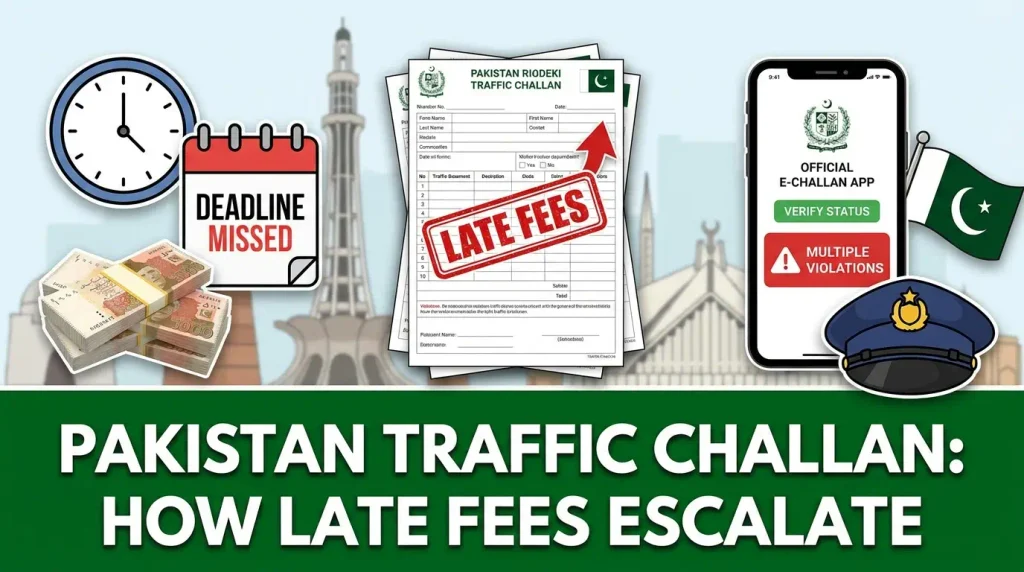
Late-payment rules can differ by province, authority, and type of challan. Exact percentages, deadlines, and timeframes may also change. For that reason, vehicle owners should check the terms shown on the official challan rather than relying on a general figure.
Original Payment Period
The challan should be paid according to the date, amount, and payment instructions shown by the issuing authority. The original payment period is the first point at which an owner can resolve the matter without allowing it to remain outstanding.
Late-Payment Stage
Where the relevant rules provide for additional charges, a late-payment stage may involve an amount different from the original fine. The exact charge and timing should be confirmed from the current challan or official traffic system.
Multiple Violations
If more than one traffic violation remains unpaid, the total outstanding amount can become larger because each violation may be treated separately. Owners should check the complete outstanding record rather than looking at only one challan.
Official Verification
Before making a payment, verify the current challan amount and status through the relevant official traffic authority. If the system provides a payment reference such as a PSID, keep that reference with your payment records.
How to Avoid These Consequences
Avoiding the problems associated with unpaid e-challans generally comes down to a few consistent habits. Vehicle owners do not need a complicated system; the main objective is to regularly check the record, resolve confirmed fines, and keep vehicle ownership information updated.
- Check your challan status regularly through the relevant provincial traffic portal.
- Do not wait for an SMS before checking whether a fine exists.
- Pay promptly once a fine has been confirmed.
- Complete ownership transfers immediately after selling a vehicle.
- Keep copies of sale agreements, transfer documents, receipts, and payment records.
- Dispute a challan through the available official correction or complaint procedure if you believe it is incorrect.
- Update your registered mobile number when your contact information changes.
- Keep a simple personal record of challans that have been checked and paid.
Keep Your Payment Records
A PSID (Payment Slip ID) is a payment reference used for certain challan payments. If your challan provides a PSID, keep it with your payment records. Payment options can vary between provinces and financial institutions, so use the method listed by the relevant authority or financial institution.
After payment, save the receipt and check the challan status through the official system when possible. Keeping proof of payment can be useful if the record does not update immediately or if a question about the payment arises later.
Be Careful With Payment Messages
If you receive a suspicious message asking for payment, do not rely on the message alone. Verify the challan through the relevant official traffic authority before entering payment information or sending money. This is particularly important because notification messages can be imitated or used in scams.
Frequently Asked Questions
Final Thought
An unpaid e-challan can remain unresolved and may become relevant when you later need to complete certain vehicle or licensing transactions. The exact consequences depend on the authority, the type of challan, and the applicable rules.
The safest approach is to check your traffic record periodically instead of waiting for an SMS or physical notice. If a challan is confirmed, review the amount and payment instructions shown by the relevant authority and resolve it through the available official process.
Vehicle owners should also complete ownership transfers properly after selling a car and keep documentation of the transaction. If a challan appears to be incorrect or is associated with a vehicle that was already sold, use the relevant authority’s dispute or correction procedure and provide supporting documents.
In short, ignoring an e-challan does not necessarily make it disappear. Regular status checks, timely resolution, proper ownership transfers, updated contact information, and accurate records can help vehicle owners avoid unnecessary complications later.